

Rommey Bahhur Is Curating More Than Collections, He’s Curating Culture

In a city obsessed with spectacle, Rommey Bahhur has mastered something far more difficult: discernment.
The Miami-based collector, gallerist, rally driver, and founder of The Curation moves through the worlds of watches, contemporary art, and storied automobiles with the precision of someone who understands that true luxury is never loud.
It’s layered. Intentional. Emotional. And above all, personal.
For Bahhur, collecting has never been about acquisition alone. It’s about storytelling. About heritage. About surrounding himself with objects that carry soul, provenance, and history, then creating spaces where those stories can
be shared with others who understand the language of craft.
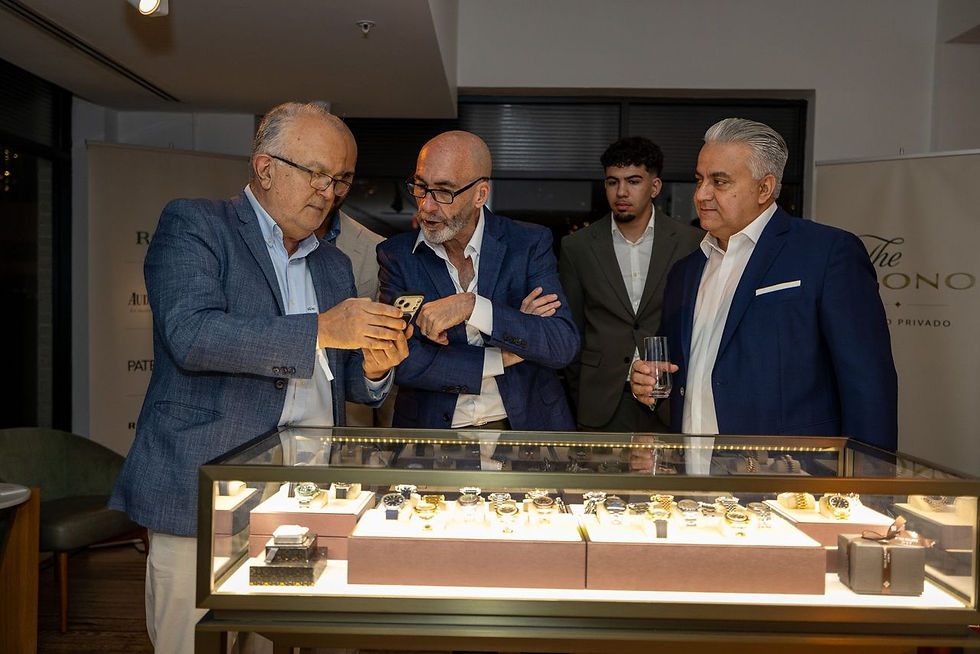
That philosophy was on full display recently atop The Moore, where Bahhur unveiled his newest venture, The Curation, during an intimate rooftop gathering that brought together collectors, creatives, gallerists,
and Miami’s cultural tastemakers under the city lights.
The evening felt less like a launch party and more like an intellectual salon disguised as a luxury event.
And that was entirely the point.
The Curation: Where Watches Become Cultural Objects
In an era where luxury watches are often reduced to flex culture and social currency, Bahhur is attempting something radically different. The Curation was built around a simple but increasingly rare belief: that great timepieces should be appreciated as cultural artifacts rather than status symbols.
For Bahhur, watches exist at the intersection of engineering, design, history, and emotion. They are miniature works of architecture worn on the body, objects that reveal as much about craftsmanship and philosophy as they do about taste.
The rooftop launch at The Moore reflected that sensibility perfectly. Guests drifted between conversations about independent watchmakers, contemporary Middle Eastern art, motorsport history, and design movements while Miami’s skyline shimmered in the background.
There was no need for theatrics. The atmosphere itself carried the weight of curation. Everything felt intentional. From the crowd to the setting to the watches themselves, the evening demonstrated Bahhur’s unique ability to bring together people who understand that luxury is ultimately about perspective, not price.
A Palestinian Lens on Art, Design, and Identity

Much of Bahhur’s sensibility is rooted in his Palestinian heritage, a cultural influence that quietly informs the way he approaches art, architecture, storytelling, and collecting.
His work consistently reflects an appreciation for objects and artists that bridge tradition with contemporary expression.
Nowhere is that more visible than through Kufa Gallery, his Wynwood-based gallery space dedicated to contemporary Arabic visual culture and thought-provoking international works.
Through the gallery, Bahhur commissioned one of the most visually significant public art projects in Miami: Ode to Freedom, the massive Arabic calligraffiti mural created by French artist Zepha. The monumental work wraps an entire building in flowing Arabic-inspired typography, transforming architecture into poetry.
Today, the mural stands as one of Wynwood’s most recognizable visual landmarks, not only because of its scale, but because of what it represents. In a district known for rapid visual consumption, Ode to Freedom offers something more contemplative: identity, movement, and cultural permanence rendered across concrete. The project positioned Bahhur as more than a collector or entrepreneur. It established him as one of the more thoughtful patrons of contemporary Arabic visual culture in the United States. And in Miami, a city increasingly defining itself through global influence and cross-cultural dialogue, that role matters.
The Romance of the Open Road
Beyond galleries and watch salons, Bahhur’s fascination with craftsmanship extends into another lifelong obsession: automobiles. But again, his approach resists superficiality. He gravitates toward cars with narrative weight, machines that feel alive with history, motorsport lineage, and emotional texture. Cars with soul.

A documented rally driver, Bahhur has competed across some of North Africa’s most demanding terrain, including the storied landscapes of Morocco, where endurance racing becomes less about speed and more about instinct, resilience, and connection to the environment. Those experiences have shaped the way he views automotive culture entirely.
To Bahhur, the best cars are not necessarily the newest or most expensive. They are the ones that carry memory. Provenance. Character. Machines connected to the broader Mediterranean tradition of racing, craftsmanship, and mechanical beauty. That perspective gives his automotive eye a depth that feels increasingly rare in today’s collector landscape. He approaches cars the same way he approaches watches and art: as vessels of history capable of bringing people together.
One Conversation, Three Worlds
What makes Bahhur particularly compelling within Miami’s evolving luxury scene is the way he refuses to separate his passions into isolated categories. For him, watches, art, and automobiles are all part of the same conversation.
Each discipline values craftsmanship.Each rewards patience and education.Each attracts people who appreciate nuance. And each serves as a gateway into deeper human connection.
That instinct, the desire to create environments where remarkable people can exchange ideas through shared appreciation, may ultimately be Bahhur’s greatest talent. The rooftop at The Moore simply became the latest proof of concept.
Because while many collectors accumulate objects, Bahhur curates energy.
He understands that the most beautiful rooms are not necessarily filled with the most expensive things, but with the right people, the right dialogue, and the right atmosphere. In Miami, a city constantly reinventing itself as a global capital of art, design, luxury, and culture, that ability feels especially resonant right now.
And Rommey Bahhur appears to be building exactly the kind of world that modern collectors increasingly crave, one where luxury feels intellectual, emotional, and deeply human once again.


Comments